How Far-Infrared Actually Penetrates the Body: The Physics Explained
Wavelength determines penetration depth — this is basic, well-established physics, not a marketing claim. Here is how it actually works, and where the honest limits of the claim are.
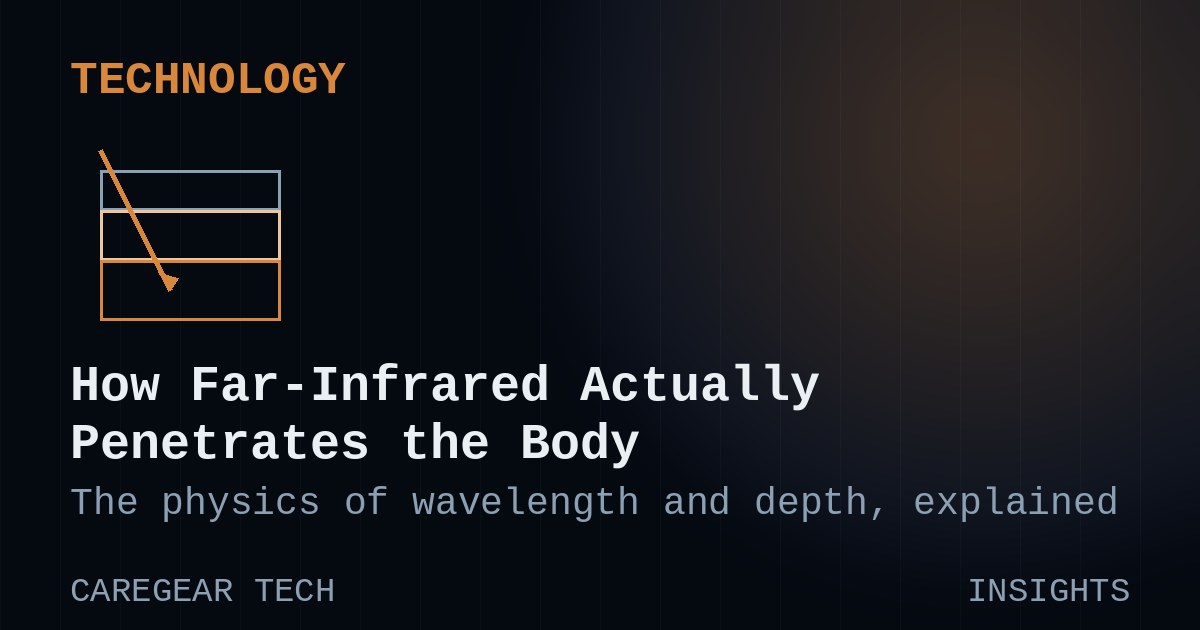
"Deep penetration" appears on a lot of thermal wellness device marketing, often without any explanation of what is actually happening physically. This is genuine, well-established physics — not a claim unique to any manufacturer — and it is worth understanding precisely so you can explain it accurately rather than repeating it as a vague buzzword.
The basic relationship: wavelength and depth
Within the infrared portion of the electromagnetic spectrum, longer wavelengths generally penetrate biological tissue more deeply than shorter ones, up to a point, because tissue absorption and scattering behavior varies by wavelength. This is standard material covered in dermatology and biomedical optics literature — the general principle that near-infrared, mid-infrared, and far-infrared behave differently with respect to tissue interaction is not in dispute.
Why "far-infrared" specifically is the commonly cited band
Far-infrared wavelengths are commonly associated with providing a warming sensation at a subsurface level rather than being absorbed almost entirely at the skin's immediate surface, which is part of why this band is the one referenced across thermal wellness devices — including the terahertz-band devices covered elsewhere on this site, since the terahertz range sits adjacent to the far-infrared band.
What this physics does and does not tell you
This explains a physical mechanism — energy reaching below the immediate skin surface — not a specific clinical outcome. As covered in our terahertz safety myths article, the responsible line to hold is: describe the physical mechanism accurately (wavelength, penetration behavior, thermal effect) without extending it into a specific medical claim a device has not been clinically evaluated for.
How to talk about this with a technical buyer
A buyer with an engineering or scientific background will notice immediately if "deep penetration" is used as an unexplained buzzword versus grounded in the actual wavelength-dependent mechanism. Being able to explain the "why" — not just assert the "what" — is what separates a credible technical conversation from a marketing slogan repeated without understanding.
Where to point someone who wants the primary science
This is a well-established area of biomedical optics and dermatology research, not a niche or disputed claim — a buyer or regulator asking for substantiation is asking a reasonable question, and pointing to established literature on infrared tissue interaction (rather than only manufacturer marketing material) is the more credible response.